One Talented Individual Is Not Enough to Win: What Football Teaches Business
One Talented Individual Is Not Enough to Win: What Football Teaches Business
A football team does not win just because it has one superstar. Victory comes from a whole system operating in sync, in which every player is not only skilled but also fulfills their role. The same is true of companies. A talented individual can deliver short-term results, but only a system delivers long-term success.
🎥 Watch the AI Talent H&HIS introduction video here.
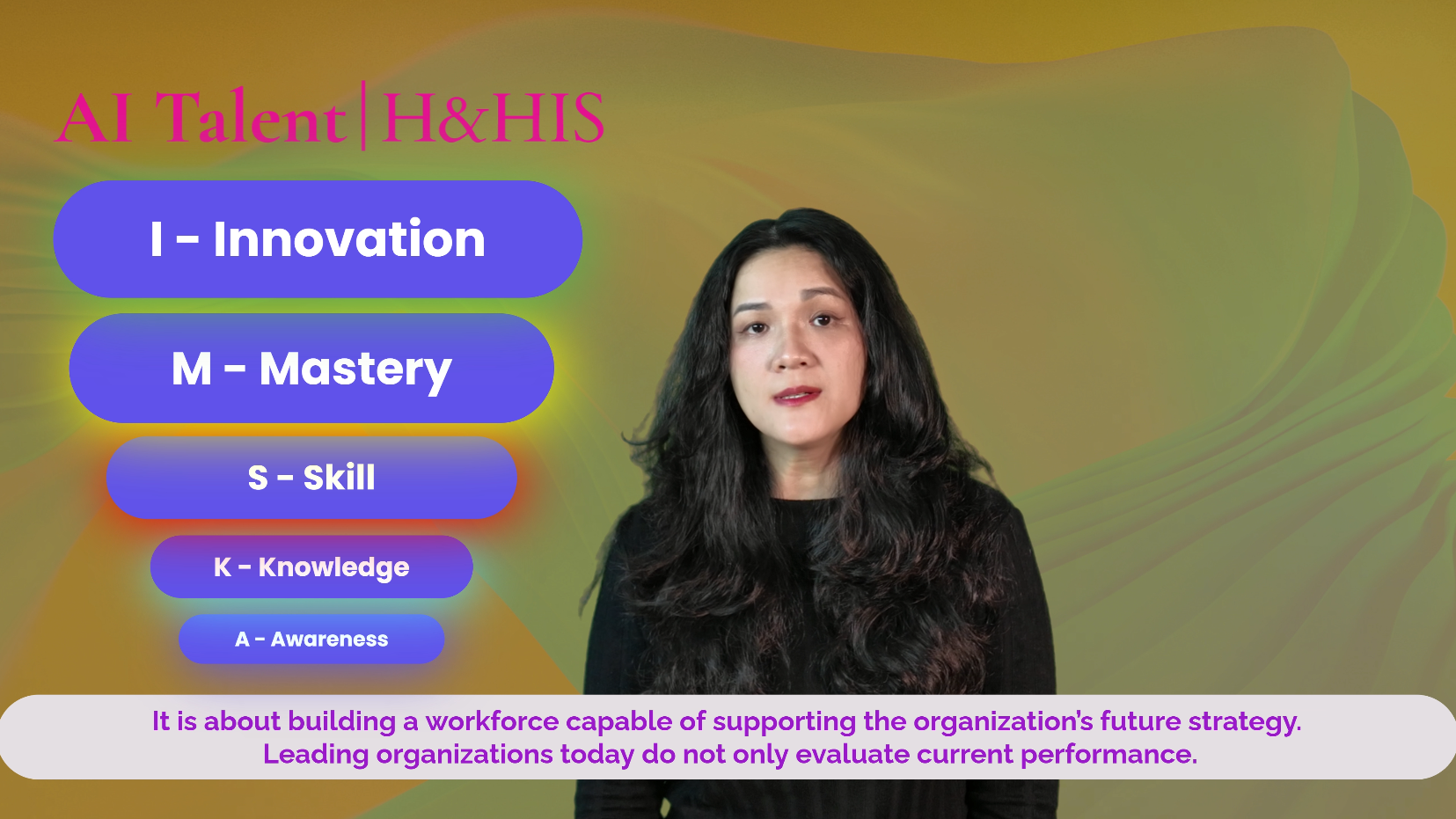
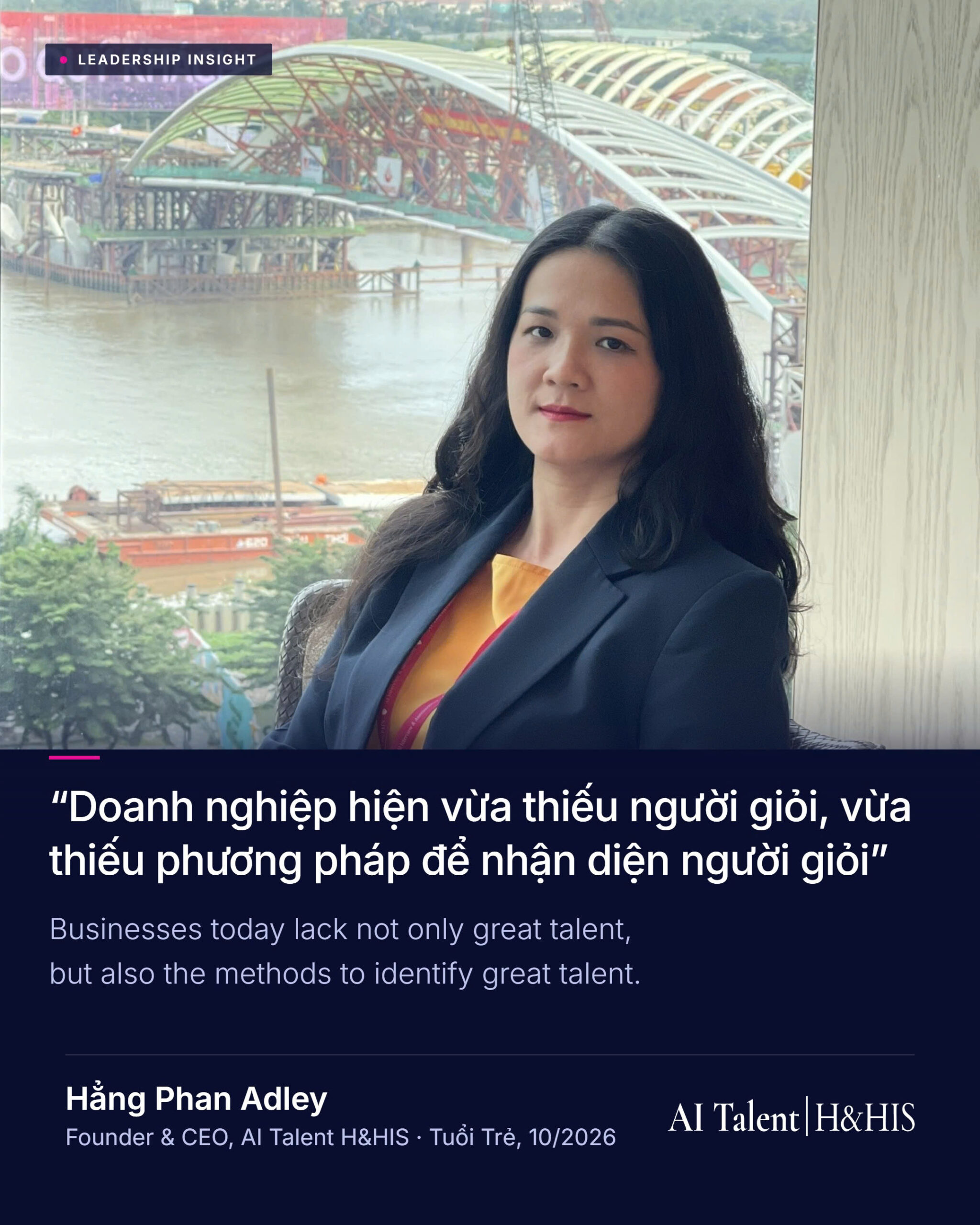
In the previous video, Ms. Hẳng Phan Adley, Founder & CEO of AI Talent H&HIS, explained that companies do not lack talented people, but that sustainable growth requires clear competency standards. In this video, she turns to another truth of equal importance: a single talented individual can rarely create success for an entire organization on their own. (Shared by CEO & Founder Hẳng Phan Adley on April 4, 2026 – Click to watch the video)
A Lesson from the Pitch
Consider sport, and football in particular. A team cannot win simply because it has one outstanding player, even if that player is Ronaldo or Messi. (Exceptional players still make an enormous difference, but their performance depends heavily on the system and the teammates around them.)
– A team may have an outstanding striker, but without support from the lines behind, the striker cannot score.
– A team may have a superstar goalkeeper, but if the defense is repeatedly out of position, the result is still a loss.
– The midfield is where the system connects. If midfielders cannot control the ball or set the tempo of the match, the attack has no chances to score and the defense comes under heavy pressure.
Every position and every player must be not only skilled but also fulfill their role within the system. A team wins only when the whole team operates in sync.
The Vietnam National Team Under Coach Park Hang-seo
Think back to the Vietnam national team under Coach Park Hang-seo. Before his tenure, the team had enjoyed years of sponsor investment, and its players had fairly good technique, yet for a long time it had no standout results and was often unstable. It is fair to say the team was not yet operating as a true system.
When Coach Park arrived, what changed was not simply the personnel, but how the whole team operated, to a professional standard. According to the analyses on record, he built very clear tactics and very high discipline. This showed in matches:
– Each player’s role was clearly defined.
– Tactics were organized to suit each phase of the match.
– Technical discipline was high, physical conditioning was optimized, and coordination between the lines was strong.
As a result, the team’s performance rose markedly. Anyone who follows football will remember that the team used to tire from the middle of the second half, while the new generation of players was fitter and far more confident. From there, the team achieved results well worth celebrating: runner-up at the 2018 AFC U-23 Championship, a historic match for the maturing of Vietnamese football, and a place in the quarter-finals of the 2019 AFC Asian Cup. (The team also won the 2018 AFF Championship and the gold medal at the 2019 SEA Games.)
This illustrates a clear principle: the change did not come from replacing all the players, but from the operating system that Coach Park built. (Alongside this was a generation of high-quality young players, but the decisive difference lay in how the team was organized and run.)
Companies Work by the Same Principle
A company may have an outstanding sales team, but if the supply function cannot guarantee sufficient stock, deliveries are late, or products fall short on quality, then however strong the sales team is, business results will be hard to achieve. And the reverse also holds:
– Strong production but weak sales means no revenue.
– Strong marketing but operations that cannot keep up means customers gradually leave.
– Good service but a product that cannot compete with rivals means the company struggles to hold its market.
Each function in a company is like a player’s position on the pitch. Every position needs clear competency standards, but more importantly, those capabilities must be designed to connect and coordinate with one another.
An Organization Is Judged by the Whole System, Not by Its Parts
According to leading organizations worldwide, an organization is not judged by its individual parts, but by how well the whole system operates. Without a system, each function optimizes for its own goals, and the organization as a whole is not optimized. (In management, this phenomenon is known as suboptimization.)
A simple illustration:
– Sales always wants to cut prices to hit targets more easily.
– Manufacturing always wants to cut costs to optimize operations.
– Finance always wants to control spending.
Each is right on its own terms, yet the whole is wrong. This is a sign of an organization lacking systems capability in management, and it is also the difference between talented individuals and organizational capability. A strong team is not one with many talented individuals, but one with a system that helps everyone work together effectively.
The Role of the CEO: Architect of the Capability System
Here the role of the CEO becomes very clear. The CEO is not only an operator, but the architect of the capability system for the entire organization. Without standards, a company does not know which capabilities it needs to build, what the organization is missing, or which direction it is developing in. The organization ends up evolving quite randomly.
The Next Mistake: Investing in Talent Without a System
From there, companies easily make a further mistake: investing heavily in people, constantly hiring talented individuals and top experts, and constantly running training programs, but without a standard competency framework to turn these people into a true team.
The result is an organization that has talented people but does not produce collective results. The company invests but does not create real organizational capability. It may still grow, but that growth is not sustainable.
Discipline Is Not Rigid Control
Back to the football team: to win, it needs discipline. Companies likewise need a system to grow. Discipline here is not rigid control. It means every person understands their role and operates to a common standard.
Two Questions for CEOs and HR
She poses a question to leaders: are you building a team, or merely assembling talented individuals?
And to HR: does the organization have a competency framework that connects everyone, or is each person following their own path?
A Platform to Help Organizations Build a Capability System
A talented individual can produce results in the short term, but only a system creates long-term success. Companies do not fail for lack of talented people. They fail because they do not turn talent into an effectively operating system.
That is why AI Talent H&HIS was built. The platform does more than help organizations interview and assess candidates. It also helps them to:
– Build competency standards for each role.
– Connect capabilities into a single system.
– Develop team capability in line with strategic direction.
In the end, a company is unlikely to win with one talented person. It wins with a strong system.
Does your organization operate as a system, or is it merely a collection of talented individuals? Contact the AI Talent H&HIS team for guidance on building a competency framework and an assessment system suited to your business.
Watch the full talk here: AI Talent H&HIS: One Talented Individual Is Not Enough to Win – YouTube
AI Talent H&HIS – Hire Smarter. Grow Faster.
Explore now: https://aitalenthhis.com
Hotline: (+84) 97 360 7502
📩 Sign up for a free trial today and start optimizing your hiring process with AI.
For expert consultation, contact: bd@hinternationalstrategy.com
AI Talent H&HIS, the leading AI-powered interview and skills assessment platform in Vietnam and Southeast Asia.
”H&HIS – The minds behind the innovation of AI Talent H&HIS“