A CEO Is Not a Title. It Is a Leadership Capability
A CEO Is Not a Title. It Is a Leadership Capability
Organizational capability does not appear by itself. It reflects clearly the CEO, who designs and leads the system that produces it. Yet many companies misunderstand what makes a CEO: not experience, a degree from abroad, or a résumé at a large corporation, but an integrated leadership competency framework. When capability fails to keep pace with strategy, execution is more likely to fail…
🎥 Watch the AI Talent H&HIS introduction video here.
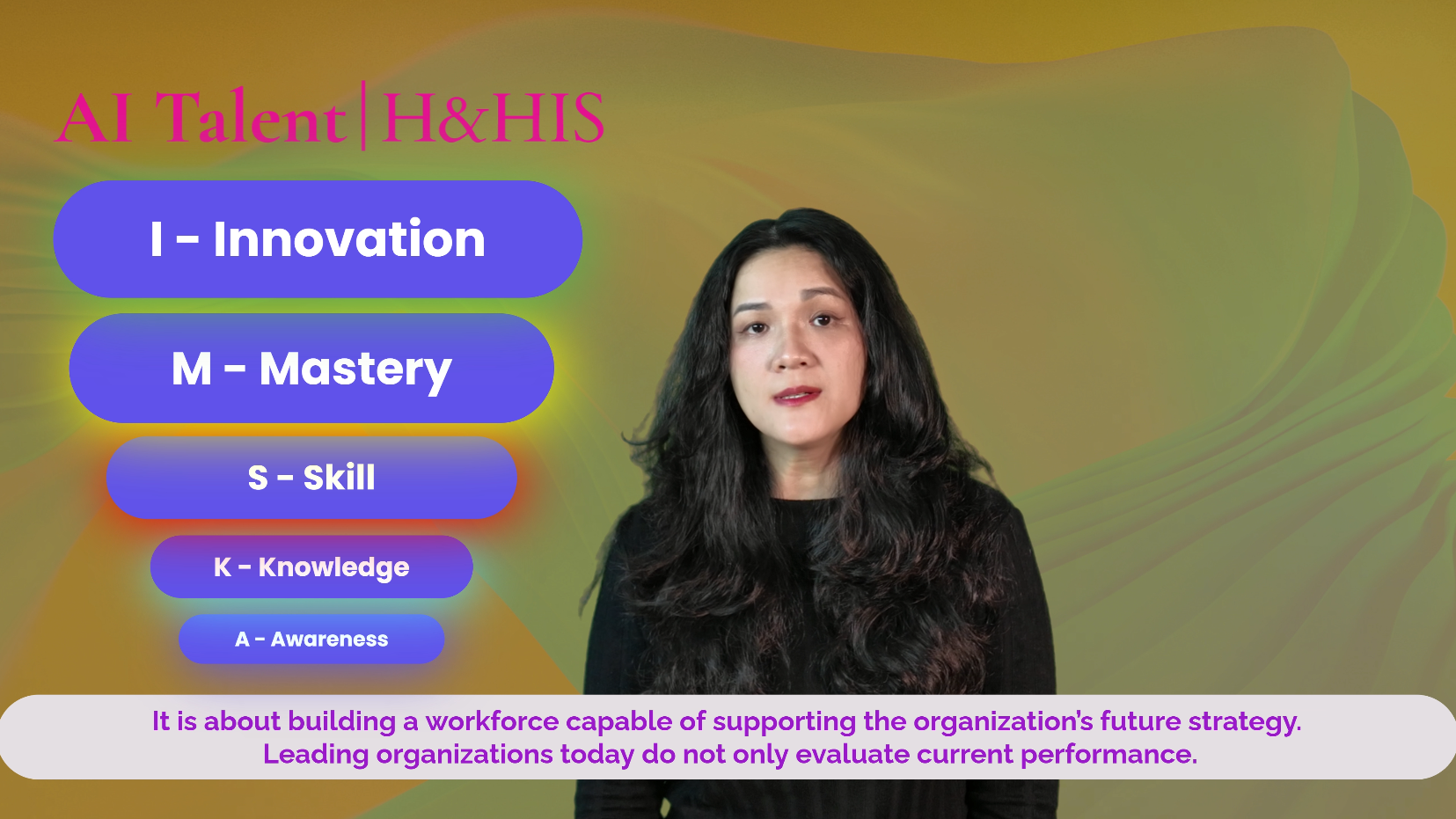
In the previous video, Ms. Hẳng Phan Adley, Founder & CEO of AI Talent H&HIS, explained that companies do not lack talented people. They lack organizational capability. In this video, she moves on to an important point: organizational capability does not appear by itself, and it reflects clearly the CEO, who designs and leads the system that produces it. (Shared by CEO & Founder Hẳng Phan Adley on April 1, 2026 – Click to watch the video)
Many Companies Misunderstand What Makes a CEO
We often assume a CEO is someone with extensive experience, an education abroad, or a career at large corporations. But a CEO is not defined by background, meaning their past, but by capability. (Experience and education remain valuable foundations, but they cannot replace a leadership competency framework.)
Capability here does not mean one, two, or three skills. It is a multi-layered competency framework, including, for example:
– Strategic thinking.
– Understanding of the business model.
– Understanding of the organization.
– Understanding of people development.
– Understanding of execution.
– Systems thinking…
And the most important element is the ability to connect all of these capabilities into a working operating system.
A Real Case: The CEO of a Plastics Company in Ho Chi Minh City
She gives the example of the CEO of a plastics company in Ho Chi Minh City, with whom her team has had the opportunity to collaborate. The company manufactures very familiar products such as plastic furniture and household goods. It is a business with a solid foundation: it had achieved a measure of success, with a factory, products, and a stable market. The CEO had also studied abroad, which suggests a strong grounding in management and modern thinking. On paper, it sounds like the ideal formula for continuing to run the business successfully.
However, once the CEO took charge, problems began to emerge. Instead of running the company on the logic of a manufacturing business, the CEO built the distribution system the way a trading company would. This created a misalignment with, and contradiction of, the market.
In the plastic furniture industry, most volume flows through traders, wholesalers, merchants, and traditional dealers. When the company built its own distribution channel, it inadvertently competed directly with its own existing dealer network. Pricing policy was not tightly controlled, which led to price erosion, and once prices have been undercut, bringing the market back to stability is extremely difficult.
The company also hired people with distribution experience, so its distribution network expanded very quickly, from Ho Chi Minh City to the North. But rapid expansion drove costs up fast while the ability to control them did not keep pace. At the same time, the company’s core competence, manufacturing, was not given the investment and priority it deserved, so the company failed to build a clear advantage in cost or quality. Channel conflict set in, and the organization became increasingly complex and difficult to run.
This is a common mistake: using the mindset of a trading company to run a manufacturing business, when each model demands an entirely different kind of leadership capability.
Where Does the Problem Lie?
The problem is not that this CEO lacks ability, nor that he or she lacks knowledge. The problem is that the CEO did not yet have the right set of capabilities for the CEO role in this particular company:
– Understands the market, but lacks systems thinking.
– Has management knowledge, but lacks an understanding of how to integrate a business model.
– Is strong in strategy, but lacks the capability to build an organization.
In other words, this is fragmented knowledge without an integrated competency framework. This is a pitfall many Vietnamese companies face. Many CEOs keep studying and upgrading themselves, but this is a matter of building organizational capability, not merely acquiring more knowledge.
The Consequences When a CEO Lacks an Integrated Competency Framework
When a CEO lacks this capability, the company will:
– Keep chasing opportunities and seeking expansion without being able to control it.
– Depend on a few talented individuals within the organization.
– Be unable to expand sustainably: it may grow in the short term, but struggle to sustain that growth over time.
Two Questions for CEOs and HR
She poses a question to leaders: are you running the business, or building a competency framework for it?
And to HR: are you building the CEO role around a clear set of competency standards, or assessing candidates only on experience and track record? Without assessing against a leadership competency framework, a CEO is merely a title. When capability does not keep pace with strategy, execution is more likely to fail.
A Platform to Build Competency Frameworks, Including for Leadership Roles
That is why AI Talent H&HIS was built. The platform does more than help organizations interview and assess candidates. It also helps them to:
– Build competency frameworks for every role, including leadership roles such as the CEO.
– Assess the gap between current capability and the competency framework.
– Recommend specific development pathways.
An organization grows sustainably when both the CEO and the team are strong in capability, and the CEO’s capability complements and strengthens that of the team. These are two sides that must be developed in parallel: it is not enough to have a strong CEO with a weak team, or the reverse. (An effective leadership team is typically one whose members compensate for one another’s weaknesses.)
Often, a company fails to expand not because of the market, but because the capability of the person at the top is not yet sufficient to develop the system.
Is your organization appointing CEOs by title or by competency framework? Contact the AI Talent H&HIS team for guidance on building a competency framework and an assessment system suited to your business.
Watch the full talk here: AI Talent H&HIS: A CEO Is Not a Title. It Is a Leadership Capability – YouTube
AI Talent H&HIS – Hire Smarter. Grow Faster.
Explore now: https://aitalenthhis.com
Hotline: (+84) 97 360 7502
📩 Sign up for a free trial today and start optimizing your hiring process with AI.
For expert consultation, contact: bd@hinternationalstrategy.com
AI Talent H&HIS, the leading AI-powered interview and skills assessment platform in Vietnam and Southeast Asia.
”H&HIS – The minds behind the innovation of AI Talent H&HIS“