Companies Dont Lack Talented People. They Lack Organizational Capability
Companies Dont Lack Talented People. They Lack Organizational Capability
An organization can have plenty of talented people and still fail to create capability. When expanding across industries, a company faces two paths: growth driven by capital, or growth driven by capability. Talented people do not create competitive advantage. The system that turns talent into organizational capability does.
🎥 Watch the AI Talent H&HIS introduction video here.
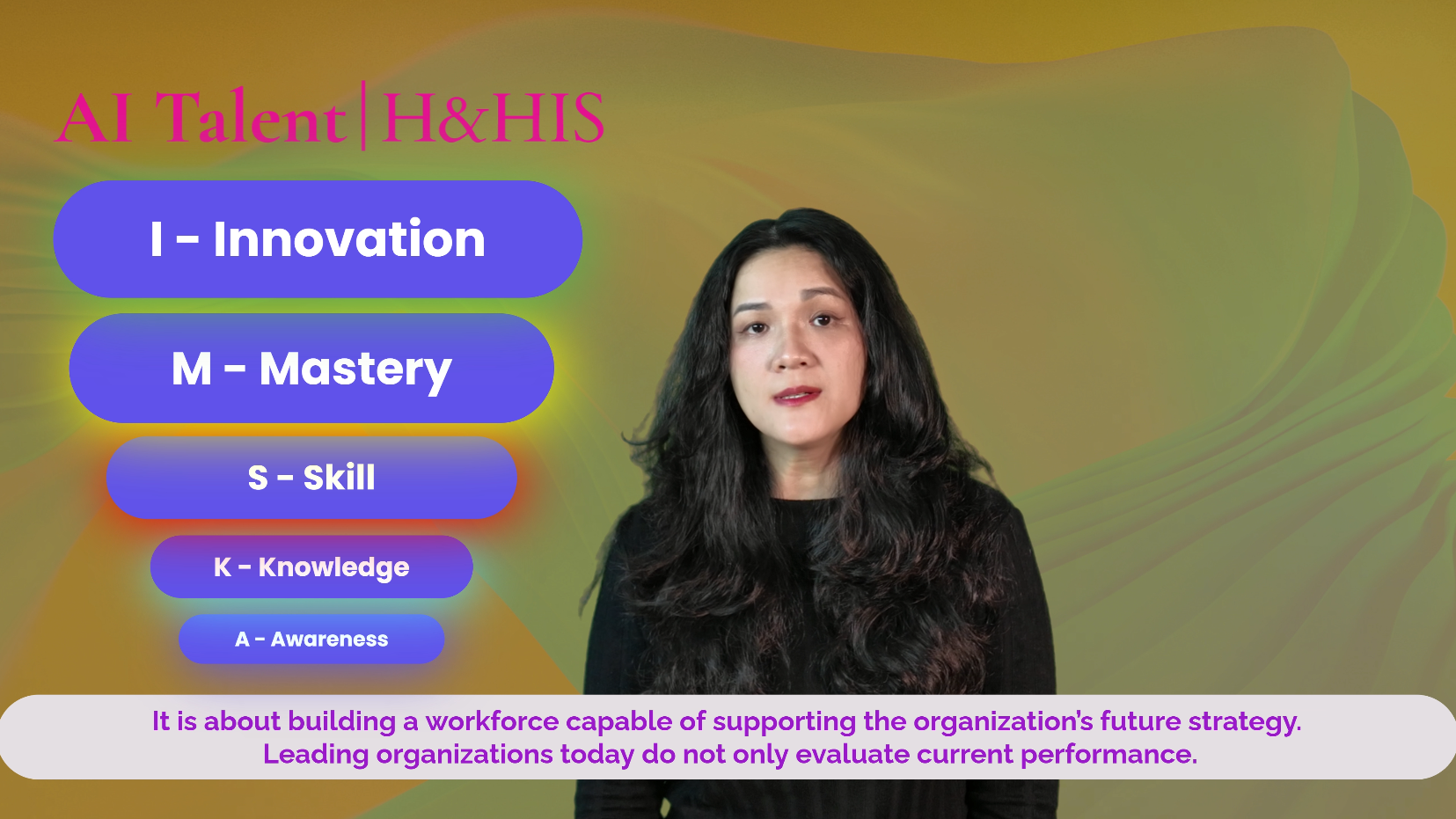
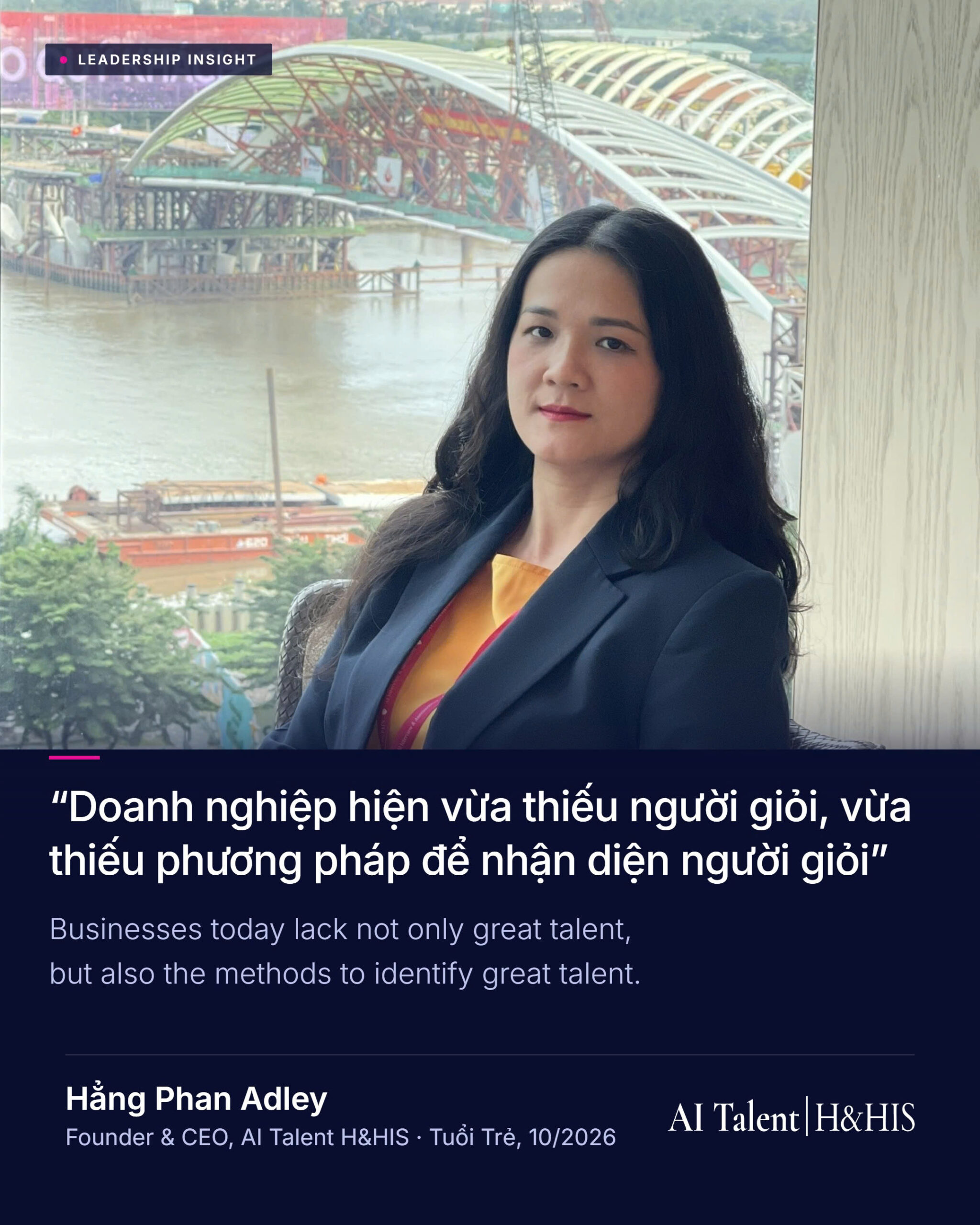
In the previous video, Ms. Hẳng Phan Adley, Founder & CEO of AI Talent H&HIS, discussed companies that have a performance management system but do not produce real performance. In this video, she explores a deeper issue: companies that have talented people, but whose organizations fail to create capability. (Shared by CEO & Founder Hẳng Phan Adley on March 31, 2026 – Click to watch the video)
A Diversified Conglomerate and Two Strategic Choices
She uses as an example a large-scale diversified conglomerate with a broad ecosystem spanning agriculture, energy, real estate, and tourism. She chose this case because her team has had the opportunity to engage and work with the group, and because it is an interesting case from a management perspective: an organization planning rapid growth and expansion into many sectors.
In such a situation, the organization faces two strategic paths:
– Capital-driven growth: the organization does everything it can to expand investment, solves problems with financial resources, and grows through scale. In the short term, this can deliver results. In the long term, however, the organization tends to become dependent on capital and gradually stagnates, because there is no mechanism to raise the capability of its people. The result is an organization that is perpetually short of capital and must keep searching for new funding.
– Capability-driven growth: growth may be somewhat slower, but it is sustainable and can be scaled over the long term.
A Sustainable Company Is Not One with Many Industries, but One with a Core Competence That Runs Across Them
Research on organizational core competence, most notably Prahalad and Hamel’s concept of core competence, shows that sustainability lies not in the number of industries a company operates in, but in the core competence that runs across all of them. Two examples illustrate this:
– Amazon: Starting in e-commerce, Amazon built core competences in large-scale logistics and technology infrastructure, including data. From that foundation, it expanded into infrastructure serving millions of businesses, streaming services, and smart devices.
– Toyota: Toyota is not just a carmaker. It is renowned for the Toyota Production System (TPS), a system for optimizing processes and eliminating waste so that performance can be scaled. Thanks to this capability, Toyota manufactures cars at optimal cost and high quality, and has since expanded into hybrids, electric vehicles, robotics, and even Woven City, an experimental city for future mobility and technology at the foot of Mount Fuji. Even as it expands across many fields, Toyota retains its foundation of operational optimization and continuous improvement. It excels at one capability and then scales it across many industries (beyond its operational foundation, Toyota’s expansion into hybrids, electric vehicles, and robotics also draws on the engineering and R&D capabilities it has accumulated over many years).
Questions to Answer Before Diversifying
From the perspective of the AI Talent H&HIS team, an organization should become a multi-industry group only when it can answer:
– Can its core competence be sustained and carried across all industries, or will each business operate in isolation, disconnected from the others and unable to leverage shared resources?
– Are its management systems strong enough to align every industry the organization intends to enter?
A Common Risk: Stable Leadership That Does Not Grow
A common risk her team observes in large organizations is a leadership team that is stable but not growing. The organization lacks a succession pipeline, lacks high-potential leaders, and lacks a talent development system. This is no longer a people problem. It is a systems problem.
The McKinsey 7S Model: Organizations Perform Better When Seven Elements Are Consistent with One Another
According to McKinsey’s 7S model, an organization is more effective when the following seven elements are consistent with one another:
– Strategy: a clear strategy.
– Structure: a sound organizational structure.
– Systems: smooth operating processes.
– Staff: the right people in the right roles.
– Skills: the organization has the capabilities it needs, with no gaps.
– Style: clear leadership that makes decisions quickly, rather than holding meetings that lead to no action.
– Shared values: at the center of the model, the whole organization thinks in the same way, rather than each subsidiary thinking differently.
Back to Toyota: it is not renowned because it has the best people in the world. It excels because it built the TPS system, in which an ordinary person can produce extraordinary results.
Many companies do not fail for lack of strategy. They fail because these seven elements do not fit together: strategy says one thing, the organization moves in another direction, people lack the necessary capabilities, and systems do not support one another. The result is that the more they do, the more they go wrong. A company may have a multi-industry expansion strategy, assets, and capital, yet lack a capability development system and a core competence.
Talented People Are Not the Competitive Advantage. The System That Produces Them Is
Companies often do not lack talented people, but they do lack the system that turns talent into organizational capability. If a company chooses to expand through capital, it may grow fast, but it will depend on that capital and struggle to sustain the advantage over time. If it builds on organizational capability, it may grow somewhat more slowly, but sustainably, and it can scale over the long term.
CEOs and HR leaders therefore need to answer:
– Are we building a corporation, or simply expanding an investment portfolio?
– Is the organization developing the next generation of leaders, or merely struggling with today’s operations?
Most companies do not lack money or capital. They lack organizational capability.
A Platform to Help Organizations Build Organizational Capability
That is why AI Talent H&HIS was built. To grow sustainably, a company needs to apply capability standards to drive the development of organizational capability. The platform does more than help organizations interview and assess candidates. It also helps them to:
– Assess the capabilities of their current workforce.
– Identify capability gaps.
– Build a talent system for sustainable growth.
In the end, companies do not lose because they lack talented people. They lose because they fail to build organizational capability.
Is your organization expanding through capital or through capability? Contact the AI Talent H&HIS team for guidance on building a competency framework and an assessment system suited to your business.
Watch the full talk here: AI Talent H&HIS: Companies Don’t Lack Talented People. They Lack Organizational Capability – YouTube
AI Talent H&HIS – Hire Smarter. Grow Faster.
Explore now: https://aitalenthhis.com
Hotline: (+84) 97 360 7502
📩 Sign up for a free trial today and start optimizing your hiring process with AI.
For expert consultation, contact: bd@hinternationalstrategy.com
AI Talent H&HIS, the leading AI-powered interview and skills assessment platform in Vietnam and Southeast Asia.
”H&HIS – The minds behind the innovation of AI Talent H&HIS“